Because it has been too slow on the forums, I thought I'd toss some of my recent machine shop pasta against the wall to see if any sticks. To be clear, I'm not a real machinist, nor do I play one on TV, but I have been noodling on a Sherline mill and lathe for almost 20 years. That said, I'm no Jay Criswell!
Back in the A&O 1.0 days I bought an early Overland Alco C630 on eBay. This was a troubled spirit that has plagued me for nearly 2 decades. After installing an NCE 408 decoder I uncovered that some jack-rabbit starts were caused by extreme cogging in a Sagami (or Salami) motor. That had to be replaced. I was a beginner hack on the mill but still managed to get a suitable Pittman 8514 installed along with a new brass flywheel. It was crude but worked, made from aluminum from Ace Hardware and NWSL universals.
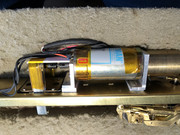
The next problem was that one (or both) of the tank drive universals kept blowing apart. Most of the gear ratio is in the gear tower, so the shafts get a lot of torque. These were bizarre designs like two pairs of cupped hands grabbing hold of a ball bearing. They didn't stay together, and when they did, created a lot of backlash. Here we see one intact OEM drive shaft after the other one blown was removed.
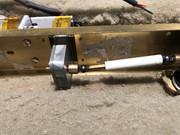
After much study I hoped I could make a new pair of drive shafts using P&D parts. I'd need to make brass adapters to attach to the 3mm shafts and translate to P&D universal parts.
The gear tower output shaft and axle gearbox input shaft were both 3mm. After measuring the OEM diameters I set out to make some adapters.
First up, for an accurate center hole we need to face off the rough end of brass stock. We must have an accurate tool post height to avoid leaving a "nubbin" that would interfere with drilling.
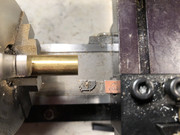
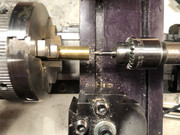
To get an accurately centered hole, I first use a spotting drill. This not only locates hole center, but adds a bevel to guide a drill bit to an accurate start.
Let's save here and move to part 2.

