Jim -
Regarding the 0.050" pitch ribbon cable, near the middle of it resides an IDC 10-pin connector that plugs into a matching header on a small PC board next to the decoder, the latter mounted on a platform above the motor. There is
just enough clearance inside the hood for the connector. I'm not sure it would fit in a shorter hood.
The function common runs the full length of the cable. The remaining wires split off, some to the front only, some to the back. You can see the front PCB mounted right behind the cab on which the various dropping resistors live for LED lighting.
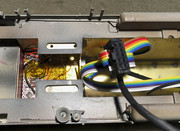
The motivation for all this was to facilitate the easy and
complete disconnection of the locomotive shell from the frame. It works because there is enough headroom for the IDC connector. So the main point was the connector, not the ribbon cable. Otherwise many wires can be easily herded using un-shrunk heat shrink tubing.
As for resistors, should you use an ESU decoder, each of the function outputs (all full-power on the L decoders) have a 32-level PWM dimmer. Finding just the right resistor value becomes a lot less critical. With today's LEDs a 1K for a pair of 3mm headlights in series should be more than bright enough. For ground lights, the now-unobtanium LED Baron 0402s from Germany would work great with 10K (wish I had ordered more!) For ground light fixtures, these are available from a seller who uses Shapeways. I think one could use an LED as large as 0603 in them. On my brass engines I'm starting to do root canals on the cast brass fixtures with 1 or 0.8mm ball-end carbide dental bits.
Here's a top view showing the 10 pin header on the far right. The PCB next to the decoder manages track pickup and motor wires. The diode is a 1500 watt bipolar TVS (transient voltage suppressor) across the rails to protect the decoder from voltage spikes caused during short circuits.
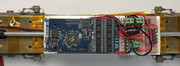
Not shown, there is also a 2 pin Swiss machine connector that connects the speaker to the decoder that can be seen in the photo in a previous post that shows the speaker. There is also a 4-pin polarized connector on the PC board that connects to an external 10 Farad ESU Power Pack. The new 5L decoders now have built-in 2 Farad Power Packs.
As for resonance above the passive radiator, don't sweat it. Typically in our engines a cavity resonance is at or above 1 kHz. The passive really doesn't put out anything up there.
Honestly, I wouldn't bother with an etched radiator. The % open area is critical. Can you get that up to 75%? Whatever is there, it needs to be acoustically transparent. Letting the front fan opening breathe can also help a lot.

