One thing I've been obsessing over is how to improve and illuminate the Red Caboose GP9 number boards. The OEM polycarbonate inserts are nearly impossible to install and they are far thicker than the shell. They can stick out on both the inside
and outside of the shell cutout. That's light leak city. Harrumpf.
One thought was to mill a brass cutting template for a thin clear styrene number board, but that would be likely to leak light around imprecisely cut edges and raised the problem of how to mount it in the shell.
I decided to just go for it and clamped an OEM insert in the Sherline mill. Two parallels and a spacer raised it up in the vise with just the thinnest bit of the edge clamped. Too much grip on the vise could crack the part, but too little might let it fly out and be ruined.
Fortunately, with light 10 thou passes I was able to thin the boards without dislodging them and to a final dimension less than the thickness of the shell. A sharp Niagara end milll wider than the board left a super smooth but nice frosty finish, perfect for diffusing light.
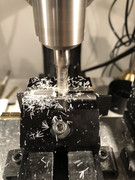
A couple swipes with a fine file on the outer sharp bevel edge added a very slight bevel that made pressing the insert in place simply and easy to adjust. I think I will install the flat milled side to the outside and sand the inside to be a secondary diffuser.
One thing I noticed is that since plastic shrinks when it cools from a liquid, the centers of the number board castings were not flat but slumped a bit. That suggests that both sides should receive a cut to make sure they are flat.
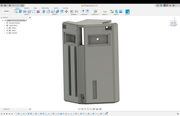
The lighting block for each end has also been refined a bit. There is a rabbet around the number board LED cavities for installation of a thin 0.010 styrene tertiary light diffuser. Also there is now a tab on the top for a small PCB board to aggregate the various LED wires to a single 5 wire harness going to the decoder. The PCB will be underhung to the tab with double stick tape. The wires are planned to be 30 AWG solid kynar wire wrap wire, which can hold its shape once formed, to a 2.5mm pitch JST XH connector.
A random thought: At least on some later EMD GPs, each number board had 3 incandescent lamps inside. Particularly on B&O engines I saw as a child, the number boards were translucent and one could see the hot spots of each bulb. What if I drilled 3 shallow holes on the inside of the inserts? Could that effect be effectively emulated?
Thoughts?

