Recent Posts

Pages: 1 ... 6 7 [8] 9 10
71
Member Projects / Re: Red Caboose GP9 remotor
« Last post by Big Train James on February 28, 2024, 09:00:20 AM »
That was quick!

I'm happy to post the speaker mod description to the forum.  I can do it here or start a separate thread, which ever you think is best.

I realize that your goal is to re-motor the Red Caboose drive, and also if possible to fit the speaker in the hood.  The goal is not to completely redesign the drive.  But I think there is an opportunity to lower the motor more than 1/4" if other steps are also implemented.  Gear towers would need to be modified, and possibly the truck blocks as well.  But with access to 3d cad and printing, those things can be accomplished without too much angst.

I think there are a lot of legacy artifacts left over in the Red Caboose design, but it predated the popularity of both DCC and sound.  A redesign could result in quite a few efficiencies.

Jim
72
Member Projects / Red Caboose GP9 remotor
« Last post by Bob on February 28, 2024, 08:21:49 AM »
The Pittman 8414 and its shorter brother 8313 are two of the most common motors used in O-scale diesels. However, they are physically large and known to be current hogs. The 8414 armature resistance is very low, resulting in a stall current of 7.9A. That gives them a lot of starting torque but that torque can't be sustained without overheating.

When driving an 8414 the back-EMF measurement algorithm of ESU decoders tends to induce a lot of electrical noise at the rails due to large current spikes. This noise can send other decoders run in consist out-to-lunch, particularly when running more than ~20 feet away from a DCC booster. The distance factor is due to bus wire inductance, not resistance. ESU recommended that we install coreless motors if possible. When out-to-lunch the decoder stops responding to DCC commands. This failure has also happened with a pair of dual vertical motor Atlas F3s.

I recently procured some Swiss-made Portescap coreless motors from an auction site. These have a stall current of only 1.2A and that should permit operation with an HO decoder. They are much smaller than a Pittman yet they produce 1.7 times the torque per Amp and they are rated for a slightly higher continuous torque.

Therefore the first reason for a new motor is the hope of eliminating out-to-lunch decoders when run in consist.

Recently one of the forum members, Big Trains James, contacted me and shared his work fitting a large Tang Band 1931 speaker module inside the car body of a Red Caboose GP9. Now that caught my interest! He described milling the sides of the plastic enclosure to make it just narrow enough to fit in the RC shell.

I had already started learning Fusion 360 to make a new fuel tank that could hold a smaller TB 1925S speaker module, so my attention turned to see if there could be enough room above a smaller Portescap motor to fit a 1931 firing up and out of the dynamic brake fan.

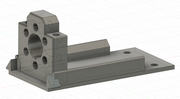
In CAD I designed a Portescap mount that lowers the motor shaft by about 1/4 inch relative to the original Pittman. Now it appears that, as Gene Wilder exclaimed in the movie Young Frankenstein, "It might just work!"

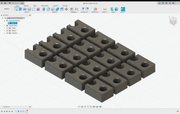
This is a work-in-progress CAD drawing of the new mount.


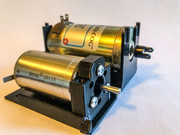
Here's a side-by-side comparison of the Portescap and Pittman motors. The new mount is 3D printed in ABS. Lock washers will be installed under the 4-40 screw heads.


This is certainly not the final design. I plan to add features to prevent wires from tangling in the drive train, and add a mounting platform for a small PC board to manage wires to the trucks and decoder.

The second reason for a new motor is to get hear more booming bass.

Bob
73
News / Jim Hediger has passed
« Last post by Bob on February 11, 2024, 08:58:41 AM »
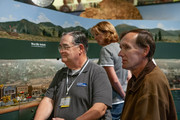
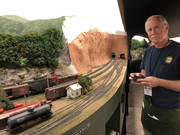
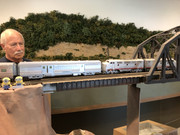
Longtime contributor to Model Railroader Jim Hediger passed on Feb 9, 2024. Here he is seen accompanied by David Stewart as he operates on the Colorado Model Railroad Museum layout during the 2009 NMRA regional convention.


His many contributions to the hobby will be missed.
74
Member Projects / Re: All wheel pickup for P&D brass Blomberg trucks
« Last post by Bob on December 09, 2023, 05:21:52 PM »
David finished repainting/weathering his F3B. With a new Loksound 5L DCC decoder and the new all-wheel pickup, stalling is a thing of the past and it creeps very slowly in the slowest speed steps.

For best operation the engineer can use the slow increment/decrement buttons on an NCE ProCab to precisely set just the right speed. Four or five different speeds should be suitable for continuous flood loading of coal hoppers.
75
Member Projects / Re: All wheel pickup for P&D brass Blomberg trucks
« Last post by Bob on November 03, 2023, 08:39:59 AM »
Finally, these wipers were installed in David's lone F3B that shoves hoppers at the Brookstone coal Loadout. This engine is receiving a new paint scheme, and an ESU decoder upgrade.


76
A&O Operations / Front Range Rail
« Last post by Bob on October 03, 2023, 12:15:04 PM »
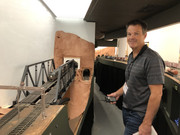
Here are a couple quick photo grabs from the Front Range Rail op session on Oct 30th.

Jeff waits for a signal at Union Gap.


Dave has a meet ain Mount Union.


Seth at Point Vincent.


David coaches Jon on Dispatching.


The big Alco C430 hauls a manifest freight over the Ohio River.


Meet at the north end home signal at Glenn Forge.


The Grand Floridian crosses the Ohio River.


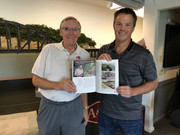
David and Jeff show off their previous layouts on adjacent pages in Tony Koester's Coal Hauling book.


A short video at the rotary.
Link to Video

77
A&O Operations / Re: Guest operators from the east coast
« Last post by Craig on September 21, 2023, 11:02:27 AM »
Looks like a fantastic time.
78
A&O Operations / Guest operators from the east coast
« Last post by Bob on September 19, 2023, 08:00:22 PM »
A large group of experienced layout operators flew out to Colorado for a 3 day extravaganza, operating on the A&O on Saturday morning 9/16 through noon, and also John Parker's and Doug Geigers layouts.

I was busy helping the guests, including the guest dispatcher, get up and running on the layout.

Here are the few photos I managed to capture. First up is the sacrificial lamb or Dispatcher. He did a great job dispatching without magnets on the model board. Trains hit OS sections very quickly on an O scale layout and he proved up to the task.


A few coal trains were unloaded on the newly-upgraded Whiting Rotaside dumper.


David reinstated "CX-FUN", a coal train that anyone can run on a loop throughout the layout. These 3 F units were featured on the cover of Model Railroader in 2006.


The B&O turn arrives on the layout, headed to Millport with a few interchange cars at the paper mill.


Jonathan runs a light helper back to Ricksburg. We were so glad you came back after your visit to A&O since your visit to to the former layout 1.0!


CX-FUN rolls across the Ohio River heading for Millport behind Bob's 3 A&O F3s.


F3 locomotives.

Craig's GP35 sees across the Ohio River pin connected truss built by Vince Griesemer.


Jonathan brings a coal train downgrade headed for the rotary dumper behind C425 #475.


A couple happy dispatchers at the end of the afternoon.


79
Member Projects / Re: Solder repairs to C&LS RSD12 trucks
« Last post by Craig on July 30, 2023, 02:04:20 PM »
Nicely done Bob. Another quality repair!!

80
Member Projects / Solder repairs to C&LS RSD12 trucks
« Last post by Bob on July 27, 2023, 10:17:23 PM »
It seems that any brass locomotive may suffer from cold solder joints. When baked in the oven, the parts don't usually get hot enough to fully melt and flow the solder paste. Instead, the solder balls sort of cling or congeal with each other in a weak mesh. The result is a dark gray matte mass instead of shiny smooth solder.

Both David and I have had solder failures on Henry Bultman's Car & Locomotive Shop RSD12s. Both failures were of truck side frame equalizing hangers on which the spacing block let go of one or both of the equalizing arms. The result was an eventual short circuit to the rail. Examination revealed that there was insufficient solder wetting on all surfaces of the 3 soldered parts.

Years ago I tried to repair my unit, but gave up in frustration. David's recent request to fix his RSD12 sent me back to work on mine first, on which I was willing to make more mistakes than on his locomotive. Time must have taught me something as my first effort was successful.

I've learned a few valuable lessons watching a fantastic retired modeler Jack Heier. He taught me in a soldering session the importance of making jigs and fixtures to hold everything brass in tight register before adding the heat. I can solder electronics including small surface mount parts, but this was a duck horse of a different color.

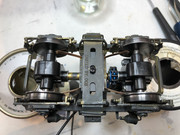
First up, David's lame duck truck. The problem occurs just to the right of the leftmost or #1 axle wheel. One side of the spacer solder joint completely failed and allowed the outside equalizing hanger to break free.


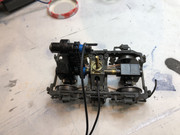
Next, the two brake hangers are in a sandwich with a milled aluminum spacer that keeps them parallel. Lots of T pins driven into Micore hold the two hangers in what will eventually be vertical alignment. They have received a generous coating of PBL 50-50 solder paste after being cleaned with a wire wheel. I used a PBL HotTip resistance soldering station with their carbon tip to make the joints, cranked up to 4 of 5.


I didn't take a photo of the final repair on David's RSD12, but here is the final result on mine. The brown stains are from clear coat that burned under heat. I dunked David's equalizer hangers in lacquer thinner and wiped them down. They didn't discolor as seen here.


Film at 11:00.
Pages: 1 ... 6 7 [8] 9 10