Recent Posts

Pages: 1 ... 5 6 [7] 8 9 10
61
Member Projects / Re: Red Caboose GP9 remotor
« Last post by david on March 07, 2024, 08:44:54 PM »
Looks great Craig. The mothership will welcome #405 with open arms.
62
Member Projects / Re: Modifying Tang Band 1815/1931 modules to fit in O scale hoods
« Last post by Bob on March 07, 2024, 06:30:37 PM »
Thanks, Jim, for sharing your findings. I will soon mill a TB 1931 and test fit it in one of my GP9 shells. First I need to rebuild the mill since it has gotten loose after more than 30 years of use. Parts are on hand.
63
Member Projects / Re: Red Caboose GP9 remotor
« Last post by Bob on March 07, 2024, 06:25:40 PM »
Glad to hear that, Craig! It is very encouraging for the Portescap remotors. Did you tune any motor parameters in the decoder or just run with the defaults?

And kudos for spending a few hours to show me around Fusion 360. That helped a LOT. I still find myself staring at the screen with a dumb look on my face thinking "there should be an easy way to do this..." It is a steep learning curve, and my designs are neither elegant nor optimal, but at least they are functional.
64
Member Projects / Re: Red Caboose GP9 remotor
« Last post by Craig on March 06, 2024, 08:47:07 PM »
I gotta say….i got my Portescap replacement motor in my Overland GP35 (pitman motor died a horrible death…killing it AND my decoder). Bob and I spent many a message talking about mount schemes and noise mitigation.

Anywho….got the motor in…got the new decoder mounted…lights hooked up and speaker hooked up. The new motor work like a DREAM.  At speed step 1… I estimate that the engine went 1/2” in 10 seconds.  And smoooooooooth to boot!

Can’t wait to get it to the mother ship and try it out.
65
Member Projects / Re: Red Caboose GP9 remotor
« Last post by Bob on March 05, 2024, 11:55:26 PM »
I just couldn't help myself.

Once the GP9 motor mount was done, I turned my focus to P&D F3s. These will be receiving Tang Band T1-2025SC speakers mounted vertically. They have an unusual tripod mount and require space underneath the bottom passive radiator for the bass to get out. The extension to the two tripod mounts near the cab is a bit flimsy. A little bit of Elmer's school rubber cement will keep it from buzzing.

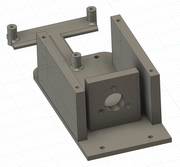
Here's the CAD. I left gaps on either side of the motor to allow heat to escape. That shouldn't be much of a problem since the coreless motor produces 1.7 times the torque per Amp compared to the Pittman 8414.


The first installation. The 4 holes on the side bars are for mounting an HO Loksound 5 decoder and a small circuit board on a slab of styrene.


Most of the sound escapes the shell through the dynamic brake intake side grills and roof exhaust grills, along with the radiator fans.


66
Member Projects / Re: Red Caboose GP9 remotor
« Last post by Bob on March 04, 2024, 08:05:59 PM »
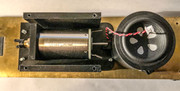
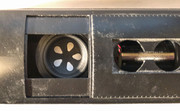
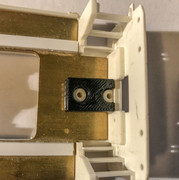
Here are a couple photos of the 3D printed parts on the brass frame. In the first photo, one of the coupler mounting pads has been pressed over the two white coupler screw bosses. It is a nice, tight fit. It took a couple iterations to get the coupler height to match that of the OEM frame.


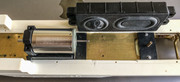
The second photo shows layout planning for the TB 1931 speaker. There is a faint pencil line on the walkway tread indicating the center of the dynamic brake fan. The speaker will be mounted close to the roof of the shell, with the round driver firing up and out the dynamic brake fan.

In a later modification of the motor mount I added a second pair of prongs that clip to the edge of the walkway. Because these were printed as an overhang, they all need light filing to proper height. What you can't see is the third fuel tank screw hole under the motor, which has been countersunk for a flathead screw. I plan to see if I can heat Cerrobend to just past melting and use it to fill the lower half of the fuel tank without warping the styrene.


As a reminder to guests, you can click your mouse on any forum photo to enlarge it. Many can be enlarged twice.
67
Member Projects / Re: Red Caboose GP9 remotor
« Last post by Bob on March 03, 2024, 11:15:59 PM »
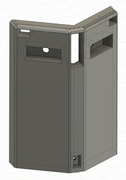
I've been 3D printing more parts for the Red Caboose GP9 builds. When substituting the now unobtanium Des Plaines Hobby brass frames for the OEM plastic ones, new coupler mounting pads need to be formed. Here is a screen snapshot from Fusion 360.


68
Member Projects / Re: Modifying Tang Band 1815/1931 modules to fit in O scale hoods
« Last post by Bob on March 03, 2024, 09:57:04 PM »
Jim -

Thank you for sharing how you modified the TB speaker to fit inside the Red Caboose shell. I have a number of 1931 modules in stock and hope to follow your lead.

And welcome back to the A&O forums. We have missed you.
69
Member Projects / Modifying Tang Band 1815/1931 modules to fit in O scale hoods
« Last post by Big Train James on February 29, 2024, 02:17:04 PM »
I was having a conversation with Bob about replacement motors for various locos, including the Red Caboose gp9.  One thing led to another, and he mentioned a revision to his plans to use a Tang Band 1931 module in the fuel tank of the Red Caboose gp9, going with a smaller 1925 module instead due to size constraints. 

I mentioned that I had modified the TB 1815 and 1931 modules to make them narrow enough to fit inside the RC gp9 hood, as well as some of the Atlas locos (gp60, sd40, mp15dc).  I'll post the specs here for anybody that wants to try the same modifications.

First though, I'll offer a couple of caveats.  First is that I based the modifications on fitting the modules into the Red Caboose and Atlas Shells.  I can't speak for models made by any other manufacturers.  I'm sure the modified modules will fit in brass locos, as it's really only the armor plate thickness plastic shells that present an issue.  Second, the 1815 and 1931 modules won't fit inside the RC hood unless the motor (or drive towers, somethings got to give) is lowered closer to the frame.  If the motor is in the stock position, the limiting dimension will be height rather than width.  Lowering the motor, and ideally the entire drive line, is another topic entirely, and Bob is discussing that now in his own thread.

The modules have been milled down to 1.320" in width, +/- .001".  That dimension was a factor of the inside width of various hoods, combined with a wall thickness dimension that Bob had mentioned years ago in a thread on the old forum.  That old discussion was revisited here in the thread "Inside a Tang Band Speaker".  It may be possible to make the modules a bit narrower, but I didn't need to find out.  I based my goal width on the models I intended to install the modules in. 

The length isn't as critical as the width, so I only removed enough material on the ends to remove the mounting tabs and clean them up like the sides. I have two modules in front of me, the lengths vary with one being 3.448" long and the other 3.465" long. 

Once milled, the modules look like this:

1815 Module


1931 Module


Milling was performed on a Sherline mill, using a sharp 5/16" diameter cutter.  The spindle speed can be fairly high, but the feed rate should be relatively slow.  I don't have exact numbers for either.  The trick is to keep the feed rate slow enough that the plastic doesn't heat up and start to melt.  It will get gummy and tend to grab the cutter.  Keep the depth of cut to .010" per pass, which helps with the heat and discourages the cutter from catching on the plastic.

A word of caution, milling the sides will remove part of the PC board strip connecting the plug to the solder pads.  Originally I thought we used a file on the PC board to avoid dulling the cutter with the glass dust.  However I was just told that it wasn't necessary to do that.  When you get to the PC board, maintain spindle speed but reduce feed rate and let the cutter do the work.  Being too aggressive could result in the cutter catching on the board, damaging it.  By the way, removing that bit of PC board doesn't affect the traces, there is still continuity from the solder pads to the plug.

The other issue to keep an eye on is that on one of my modules, milling the sides revealed a short gap between the module face plate and rear housing.  I suspect there was a lack of adhesive or sealant in that position.  It only appears on one of probably eight total modules that were modified, so I think it's an anomaly.  Following is a picture of one of the 1931 modules with the gap.  If I push on the speaker cone, the passive radiator doesn't move in response, and the opposite is true.  I plan to patch that hole with some epoxy eventually.


For reference sake, I measure the inside width of the RC gp9 shell at 1.358" just below the roof on either end of the dynamic hatch.  I figure this part of the shell is held at a constant width unlike the bottom edge, but also I presume that the module would be placed closer to the roof than the walkway.

Theoretically the 1.320" width also allows the modules to fit inside common Atlas hoods, but it's a pretty snug fit.  I'd really like to have a bit more room for a gap between the module and the shell sides, since I don't know if it's likely that the module will make the shell vibrate.  But at this point I'm not sure how much more material is available is safe to remove from the enclosure. 

I think that covers everything, at least everything I could think of at the moment. 

Jim
70
Member Projects / Re: Red Caboose GP9 remotor
« Last post by Bob on February 28, 2024, 01:15:30 PM »
Jim -

Feel free to start another topic. I want you to get full credit for your idea of a 1931 inside the GP9 shell and have breathing room to expound on your thoughts of reworking the drive train should you desire. As you point out the RC design is quite old and harkens back to the days before DCC and sound.

Welcome back to the forums. It has been quite a while.

Bob
Pages: 1 ... 5 6 [7] 8 9 10